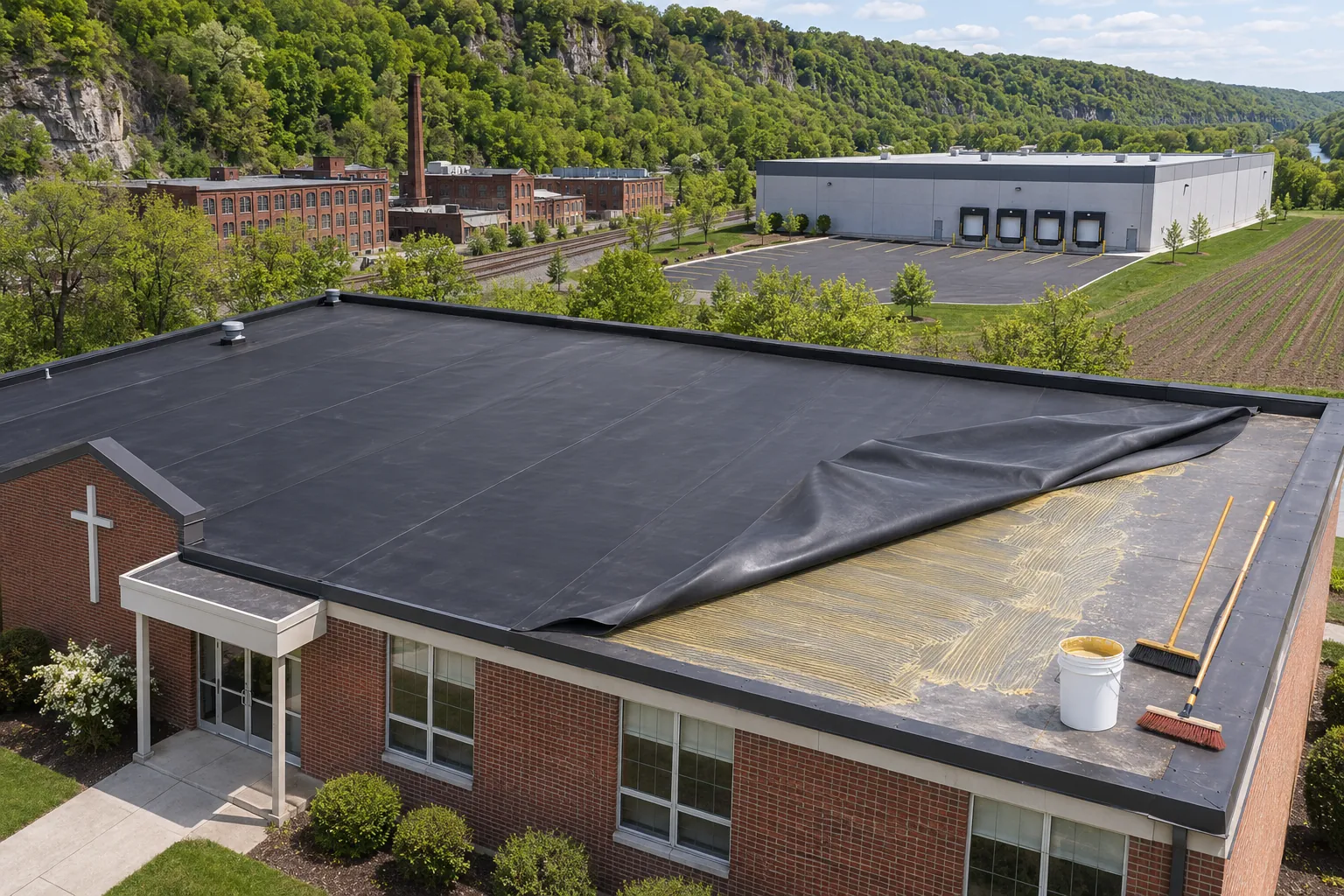
EPDM Roofing
Rubber sheets suit roofs full of small pipes and tall parapets, where taped laps and cured flashing are easier to detail.
EPDM roofing in Easton
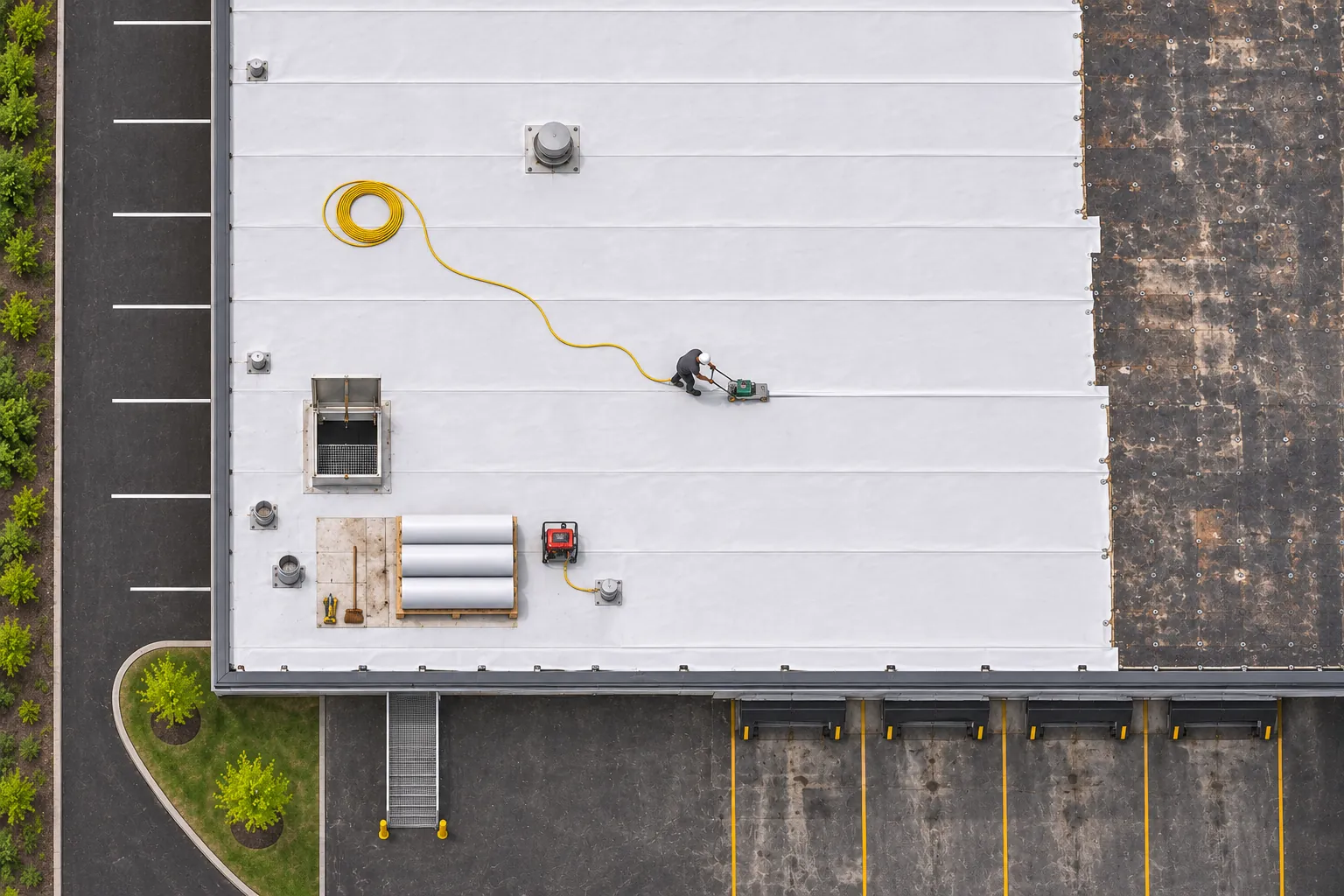
As an Easton TPO roofing contractor, we install white single-ply TPO over new insulation, welding every seam with hot air and flashing every curb.
Easton TPO roofing works best on wide, flat fields with a dry or replaceable substrate. The table shows what we look for and what has to be fixed first.
| Factor | Good Fit for TPO | Check or Fix First |
|---|---|---|
| Existing layers | One covering with dry insulation, or a full tear-off | Two coverings already on the deck |
| Insulation | Dry board confirmed by core cuts | Wet areas mapped and removed |
| Roof traffic | Units serviced along a marked path | Heavy daily foot traffic with no pads |
| Exhaust | Office and warehouse fans | Grease or oil discharge onto the field |
| Drainage | Interior drains or scuppers with taper | Low bays with crushed board |
| Season | Dry surface above the welding limits | Frost or ice on the substrate |
These are the conditions that send owners looking for a new TPO roof, matched to the roof detail behind each one.
Leaks near the overhead doors show up first in rain driven from the west.
Wind lifts old gravel stop or drip edge and opens the membrane behind it.
Summer heat builds under a dark roof over the front offices.
An old black or gravel roof absorbs sun that a white TPO sheet reflects.
Standing water stays two days after rain near the middle bays.
Insulation laid dead level leaves water between drains with nowhere to go.
Ceiling tiles under each exhaust fan show the same ring.
Base flashing that stops a few inches up the curb lets splash water behind it.
Repair crews keep returning to the same section after each storm.
Glued or taped seams on an aging sheet open faster than they can be resealed.
Melt freezes again overnight in the same low corner of the roof.
Leaves and grit block drain baskets, and water backs up against the curbs.
The sheet is the same; what goes under it and how it is held down changes with the building.
Removal to the deck, deck repairs, new tapered insulation, cover board, and a fastened or adhered sheet.
One dry existing layer stays in place when cores confirm it; a new board and sheet go over it.
Surface temperature and moisture are read at the work area before welding or adhering each section.
Sloped board is cut to move water from low bays into the drains and scuppers.
A new TPO roof changes how the building handles water, heat, and service traffic.
Hot air fuses each lap into the sheet beside it.
A light roof keeps summer heat off the offices below.
New taper sends water to outlets that used to sit high.
Pre-formed pieces tie each curb to the field sheet.
Fresh edge metal holds the sheet down along the walls.
Pads mark the path from the hatch to each unit.
Replacing wet insulation brings back its heat value.
Layer notes and photos stay with the building.
Call before the next heavy rain. We will check the laps, cut cores, and tell you whether a recover or a tear-off makes sense.
(484) 978-7949Call UsFive decisions in order, settled on the roof before the next one starts.
Cores show the layers and moisture; we also photograph each curb, drain, and stretch of edge metal.
Dry single layers can stay under a recover. Wet board or two coverings come off to the deck.
Deck type, wind exposure at the edges, and the cover board decide how the sheet is held down.
Areas are sized to weld and close in one day, with docks and entrances kept clear of hoisting.
Every weld is probed, drains are run with water, and you get the photos and layer notes.
When TPO is the wrong match for a building, one of these usually fits.
Rubber sheets suit roofs full of small pipes and tall parapets, where taped laps and cured flashing are easier to detail.
EPDM roofing in Easton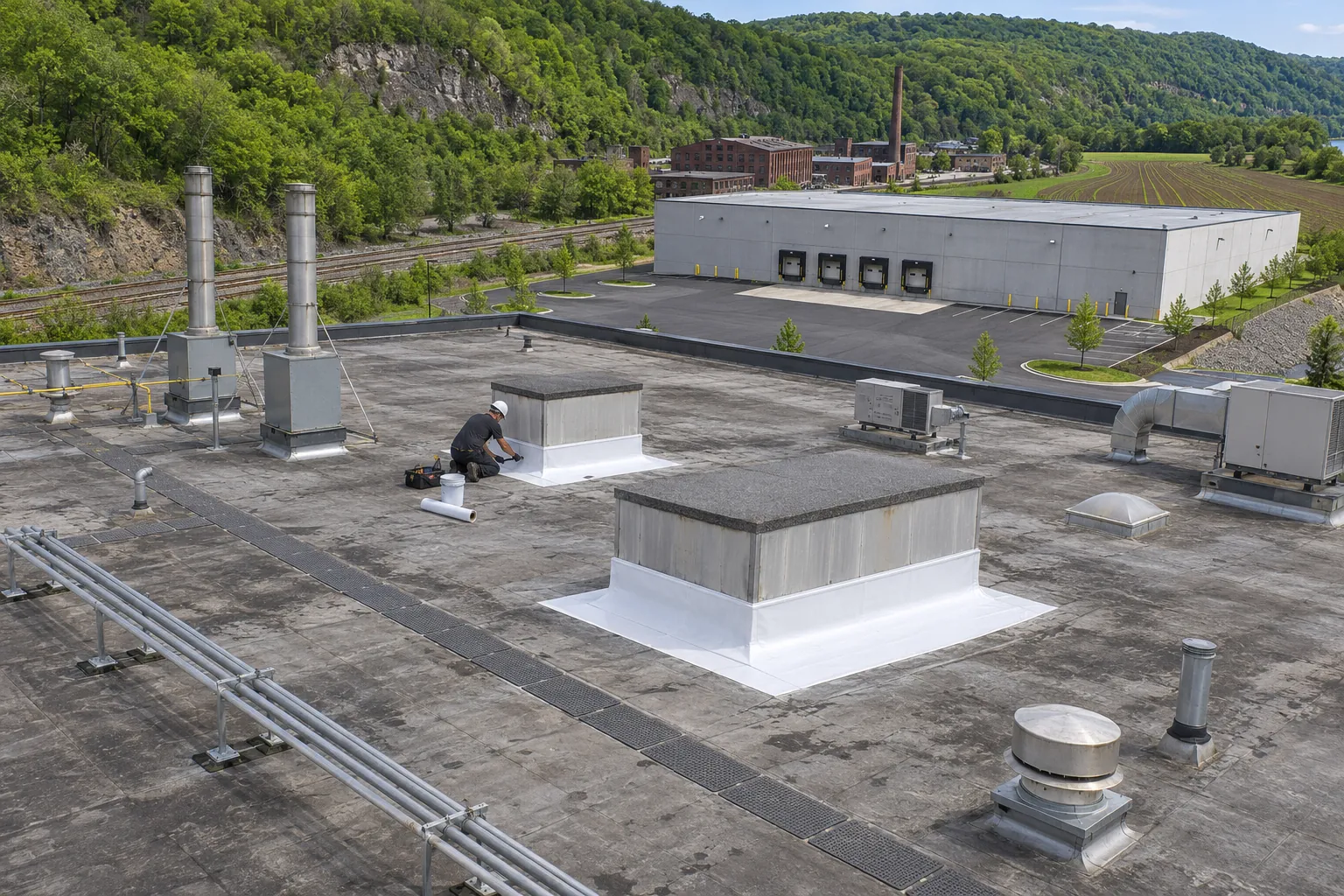
Plant roofs with stacks and process exhaust need flashing and walkways chosen for that exposure.
Industrial roofing in Easton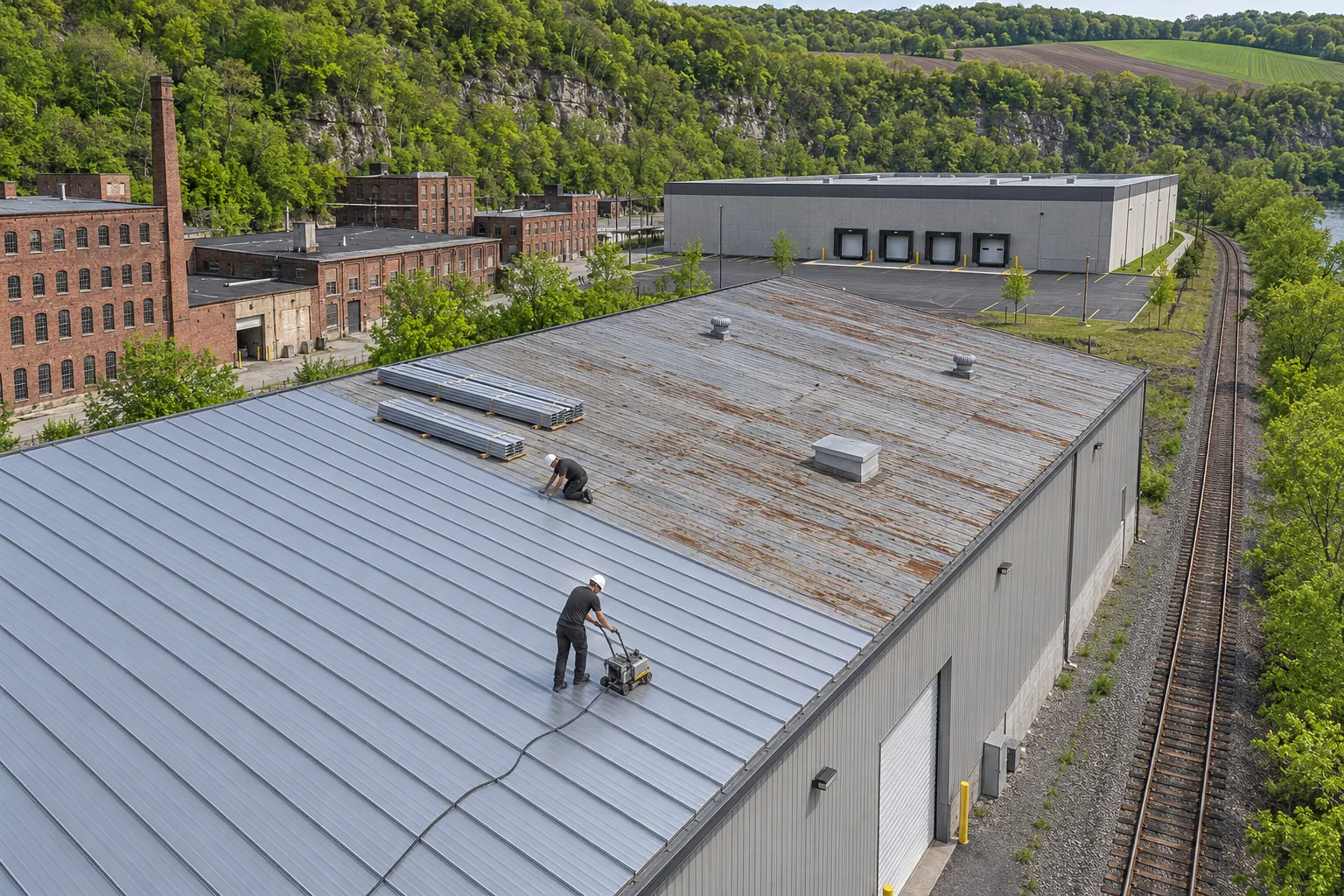
Standing-seam panels fit steel buildings and flat roofs that need new pitch.
Commercial metal roofing in EastonStraight answers on price, recovers, winter welding, and service life.
Preparation and the work around the sheet. Size, sheet thickness, insulation, tear-off layers, deck repair, edge metal, flashing, and rooftop units all add to the scope. Access, staging, and the season matter too, so a broad price per square foot leaves out most of what sets the number.
Only after the insulation is tested. Cores show whether the board is wet or crushed, and we check attachment and compatibility with the new layers. A new sheet over hidden moisture keeps the problem in the building, and heights at drains and curbs still need work.
Seam welding and adhesives respond to the surface, so the air temperature tells only part of the story. We read temperature and moisture at the work area, follow the product limits, and run test welds as conditions change across the roof.
Nobody can promise a number. Sun, foot traffic, installation quality, and upkeep differ on every roof. We check seams, drains, punctures, and flashing movement over time, and plan repairs on what the roof shows rather than a year on a chart.
It can be slick when wet or frosted. Walkway pads along the service paths give technicians grip and protect the sheet from tool drops and boot wear.
Thickness is chosen with the insulation, attachment, and traffic on your roof. Thicker sheets add material over the reinforcing scrim, which helps where technicians walk and tools drop. The proposal names the thickness for each section so bids compare evenly.
Send the address and roof size if you know it. We will cut cores, check the seams and curbs, and write up the TPO assembly that fits.