
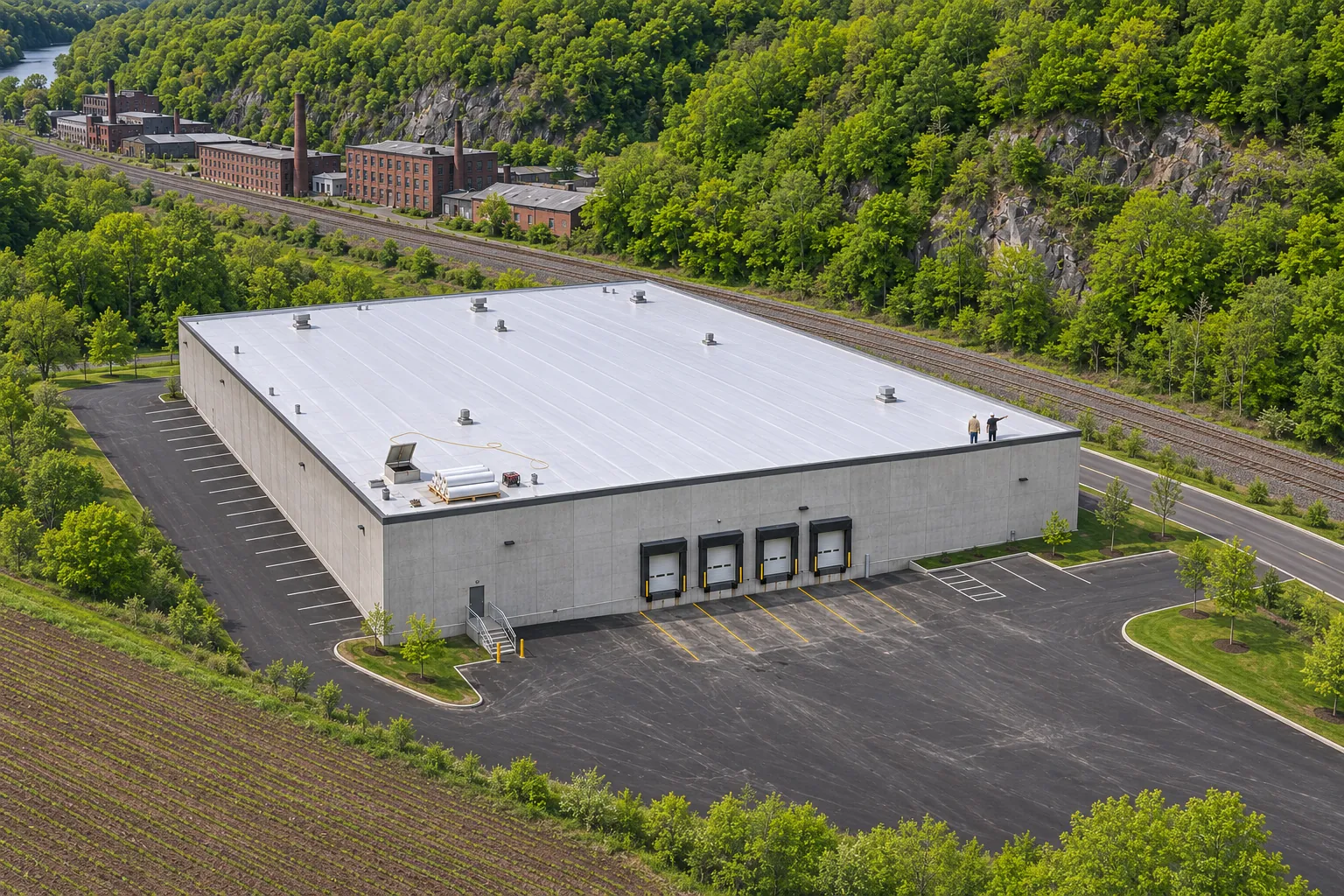
Wide drone view of a warehouse with a white flat roof in a wooded river valley
Owner Questions

Easton Commercial Roofing FAQ

Answers on Membranes, Metal, Weather, and Building Code

This Easton commercial roofing FAQ answers what owners and facility managers ask before a TPO, EPDM, industrial, or metal roof goes on.

  • QuestionsThirty Owner Questions
  • TopicsSeven Groups
  • More HelpCall With Your Address

Easton Commercial Roofing FAQ by Topic

We sorted the Easton commercial roofing FAQ into seven topics. Jump to the one that matches your building.

Defining a Commercial Roofing Project in Easton, PA

Which buildings count, winter work, comparing proposals, and why a flat rate falls short.

Does roofing on a church hall fall within commercial roofing work?

A church hall is an institutional building whose roofing can be addressed within commercial roof work. We assess its covering, insulation, drainage and connections as an assembly, with access and protection planned around occupancy. The building’s use helps shape the sequence, but the underlying roof condition still needs to be investigated.

What can make a winter commercial roof replacement workable in Easton?

Winter replacement needs safe access, dry substrates and a sequence that keeps exposed areas protected. For Easton, PA buildings, we would check installation limits for the selected materials and plan temporary closures. Ice at gutters or drains and changing snowmelt paths also matter when deciding which sections can be opened and completed.

Which roofing proposal details help a commercial owner compare contractors?

Removal limits, assembly specifications and responsibilities at equipment connections help an owner compare roofing proposals. We also identify assumptions about deck damage, insulation and occupied-building protection. Matching those details matters because proposals describing the same roof area can still include different preparation, staging or retained components that affect the actual work.

Can a square-foot roofing rate establish the price for an Easton building?

A square-foot rate cannot establish the complete price without a roof inspection. For Easton, PA work, we assess area, system and thickness, insulation, tear-off layers, deck repairs, edge metal, flashing and equipment. Access, staging and season also shape the scope, so pricing must relate to the specific building and proposed assembly.

TPO Roofing Questions

What drives a TPO price, recovers over old insulation, cold-surface welding, and service life.

What can raise the installation scope behind a TPO roofing price?

Preparation and changes beneath or around the membrane can expand the TPO installation scope. A roof inspection sets the price after we assess size, system and thickness, insulation, tear-off layers, deck repair, edge metal, flashing and rooftop equipment. Access, staging and season also need consideration before the work is reduced to a broad area-based comparison.

Can TPO cover an old roof with uncertain insulation condition?

Uncertain insulation condition needs investigation before a TPO recover is selected. We identify moisture and unsuitable underlying material, then assess attachment and compatibility for the proposed assembly. A new membrane should not be used to preserve a concealed problem, and the design must still address heights and connections at drains or curbs.

Why check roof surface temperature during cold-weather TPO work?

Roof surface conditions affect preparation, seam welding and any adhesive used in the chosen TPO assembly. We check temperature and moisture at the work area rather than assume air conditions describe the substrate. Installation needs to follow the product requirements and proper seam checks as conditions change across the roof.

Can a TPO roof be promised a particular long service life?

A particular service life should not be promised for TPO because exposure, installation and maintenance differ between roofs. We evaluate seam condition, drainage, punctures and flashing movement when considering continued use. Planning should allow inspection and compatible repairs rather than rely on a fixed age as proof that the roof will remain serviceable.

EPDM Rubber Roofing Questions

What belongs in an EPDM price, replacement timing, freeze-thaw checks, and fit.

Which parts of an EPDM replacement belong in the building’s price?

The price should cover the EPDM assembly and related work established through roof inspection. We include size, system and thickness, insulation, tear-off layers, deck repairs, edge metal, flashing and equipment connections. Access, staging and season also affect the scope, so the rubber sheet itself is only one part of the proposed project.

Is EPDM replacement timing better judged by age or condition?

Condition is more useful than age alone when deciding EPDM replacement timing. We inspect seams, perimeter stress, traffic damage and moisture beneath affected areas to judge serviceability. Maintenance records help explain how the roof has changed, but neither those records nor an average lifespan can promise performance through a particular future date.

How can freeze-thaw conditions expose EPDM roof weaknesses?

Freeze-thaw conditions can expose weaknesses where water reaches damaged seams or flashing and drainage is obstructed. We examine outlets, low areas and stressed connections after the roof is safely accessible. EPDM’s flexible sheet still depends on secure attachment and details, so those maintenance concerns stay with the membrane.

When is rubber roofing suitable for a commercial building?

EPDM rubber roofing may suit a commercial building when its assembly and attachment match the structure, exposure and upkeep needs. We compare drainage, equipment traffic and compatible transitions before recommending it. The covering should be evaluated together with insulation and flashing rather than selected from the rubber roofing description alone.

Seeing Something on Your Roof the Answers Skip?

Every roof has its own layers and details. Call and we will look at yours, from the deck to the coping.

(484) 978-7949Call Us

Industrial Roofing Questions From Plant Managers

Packaging plant operations, exhaust and humidity, walkways, and material choice.

How does a packaging plant’s operation affect industrial roofing costs?

A packaging operation can affect access, protection and installation sequencing within the roofing scope. We establish price by inspecting size, system and thickness, insulation, tear-off layers, deck repair, edge metal, flashing and equipment. Staging and season also matter, particularly where removal above active production needs to be divided into controlled work areas.

What should manufacturing facilities prioritize in a new roof assembly?

Manufacturing facilities should prioritize an assembly suited to exhaust, indoor moisture, equipment access and the operation below. We examine how those exposures meet at curbs, insulation and the deck before selecting materials. Installation planning must also identify any isolation or protection needed while roof sections are removed above sensitive processes.

Can walkway protection interfere with an industrial roof’s drainage?

Walkway protection can interfere with drainage if it obstructs runoff or access to outlets. We plan compatible protection along necessary service routes while keeping water paths and inspection points available. The arrangement should fit equipment maintenance without covering vulnerable details or encouraging unnecessary traffic across the rest of the membrane.

How should industrial roofing materials be compared for a packaging plant?

Industrial materials should be compared against the plant’s actual exposure and the complete proposed assembly. We review exhaust contact, interior humidity, service traffic and the condition of the substrate. A covering that suits one facility may need different details elsewhere, so material selection should remain tied to drainage and operating requirements.

Commercial Metal Roofing Questions

Service life, wet snow, retrofit framing, and the details that keep panels dry.

What can shorten the useful life of a new metal roof?

Unresolved corrosion exposure, defective attachments and poor movement details can shorten a metal roof’s useful service. We plan compatible components and maintainable flashing, then recommend condition-based checks after installation. Sound panels do not protect the building independently of their connections, and a new roof still needs attention to drainage and damage.

How should heavy wet snow be addressed in metal roof planning?

Heavy wet snow needs consideration through the building’s complete structural design, including supports and connections. We identify roof geometry and areas where drifting could affect the assembly, with qualified review of capacity. The metal covering alone does not establish an allowable load, so planning should not rely on a guessed snow threshold.

Can retrofit framing simply be fastened wherever an old roof looks sound?

Retrofit framing needs a designed load path into suitable existing supports, not attachment based on surface appearance. We assess structural condition, connection locations and the proposed assembly’s geometry before defining the work. Creating a new slope should not leave the supporting roof’s capacity or concealed deterioration unresolved beneath the retrofit.

Which metal roof problems should installation details be designed to avoid?

Installation details should address panel movement, unsuitable metal combinations, unreliable fasteners and weak flashing connections. We review those risks together with drainage and equipment penetrations before selecting the system. Many recurring leaks arise at joints rather than in the panel field, so attention to connections matters alongside the choice of metal covering.

Weather, Insurance, and Code Questions

Membrane upkeep, humid brick warehouses, storm checks, coverage, and the state code.

Should an Easton warehouse compare EPDM and TPO maintenance needs?

Maintenance needs belong in an EPDM and TPO comparison for an Easton, PA warehouse. We examine service traffic, drainage and access around equipment alongside the different seam methods. The preferred assembly should fit the actual roof and its upkeep plan rather than rely on a general claim that one membrane is suitable everywhere.

Can indoor humidity affect a riverfront brick warehouse’s replacement roof?

Indoor humidity can affect a replacement assembly if condensation or air leakage remains unresolved within a brick warehouse. We investigate those conditions alongside rain entry at walls and flashing before finalizing the scope. Renewing the outer covering should not be expected to correct moisture that continues to develop below or beside it.

What should a new commercial roof be checked for after summer storms?

After summer storms, a new roof needs checks for hail punctures, displaced edges and disturbed penetration details. We inspect drainage for debris as well as damage across the covering once access is safe. New defects on a recent installation still deserve attention, and repairs should follow the actual storm findings.

Does replacing a commercial roof automatically change its insurance coverage?

Replacement does not automatically establish a change in coverage or premiums. The policy and insurer’s assessment determine the outcome, including treatment of existing damage and its cause. We can document the proposed roof and inspection findings, but the owner should confirm insurance terms directly without assuming the project creates a particular benefit.

What should Easton reroofing documents identify for code review?

Easton, PA reroofing documents should identify the existing layers, proposed removal and changes at insulation or supporting components. The statewide framework is Pennsylvania’s UCC. We would present those construction details to the reviewing authority so the discussion reflects the full assembly instead of describing the project only by its new covering.

Questions From Owners in Our Other Towns

Warehouses, coping, rooftop equipment, low areas, and service access in five towns.

What should a Morrisville warehouse clarify before choosing its next roof?

A Morrisville warehouse should clarify moisture extent, deck condition and drainage needs before choosing its replacement assembly. We also review loading operations and protection of contents beneath the removal areas. Those findings establish what can remain and how work can proceed, allowing the material decision to follow an understood building scope.

Can an East Stroudsburg roof replacement leave defective coping untouched?

Defective coping should be addressed in the planning for an East Stroudsburg roof replacement because it can admit water above new flashing. We inspect its joints and attachment alongside the roof perimeter. A renewed membrane cannot resolve a separate entry route through a parapet cap that remains unsuitable.

Why should a Wilson facility coordinate equipment work before reroofing?

A Wilson facility should coordinate equipment work before reroofing where curbs, supports or connections affect the new assembly. We establish any lifting or isolation tasks before removal reaches those areas. That sequence helps avoid opening newly completed roofing to resolve an equipment detail that was not included in the original plan.

How should low areas be assessed during Clifton Heights reroofing plans?

Low areas in a Clifton Heights roof need their drainage cause assessed before a replacement layout is finalized. We inspect outlets, insulation shape and supporting conditions rather than assume new covering will remove puddles. Any necessary correction should be part of the scope so the renewed roof avoids repeating the same runoff problem.

What should a Folcroft commercial roof provide for future servicing?

A Folcroft roof should provide practical access to equipment and inspection points while preserving drainage paths. We consider compatible route protection and the position of vulnerable seams or flashing during design. Future upkeep needs should be built into the layout, rather than left to technicians choosing paths across unprotected roofing after installation.

Ask What the Easton Commercial Roofing FAQ Left Out

Send your address and a line about the roof, or call. We will answer with what we find on your building.

Call Us (484) 978-7949